
Influencer Marketing Strategy: How to Build a Successful Campaign in 2026
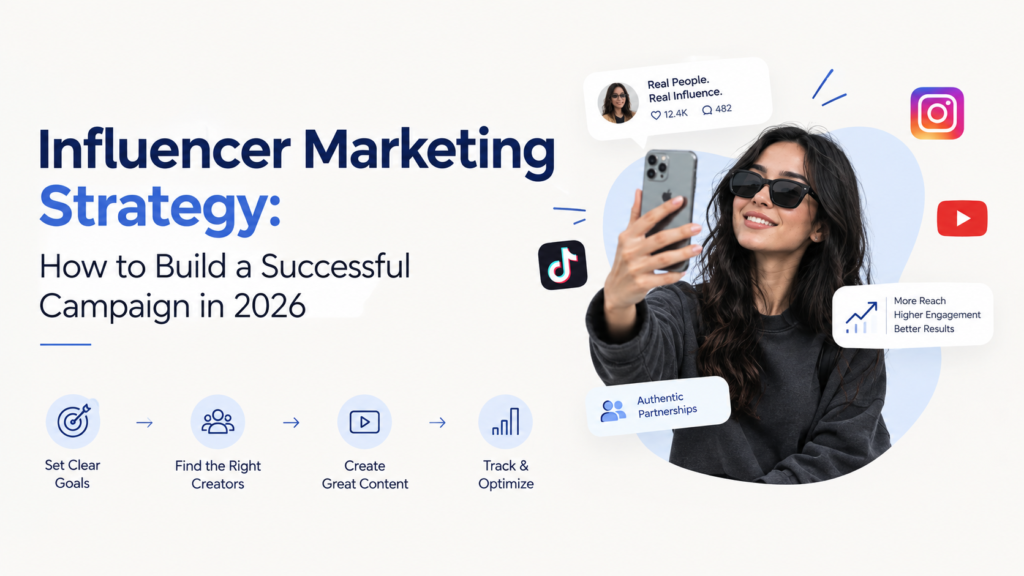
Influencer marketing has become an important part of modern digital marketing. As consumers spend more time on social media, brands are looking for effective ways to connect with their target audiences. An effective influencer marketing strategy can help businesses increase brand awareness, build credibility, generate engagement, and ultimately drive conversions.
However, successful influencer marketing is not simply about paying someone with a large following to promote a product. A strong influencer marketing strategy requires careful planning, choosing suitable creators, producing relevant content, and measuring campaign performance.
In 2026, brands need a more strategic approach to influencer campaigns. An effective influencer marketing strategy should consider the target audience, social media platforms, creator relevance, content quality, budget, engagement, and campaign objectives.
In this blog, we will explore how brands can create a successful influencer marketing strategy in 2026 and use influencer partnerships to achieve meaningful marketing results. https://sproutsocial.com/insights/influencer-marketing/
What Is an Influencer Marketing Strategy?
An influencer marketing strategy is a planned approach that businesses use to collaborate with social media creators to promote their products, services, or brand.
Influencers have already built audiences around particular interests such as fitness, beauty, technology, gaming, fashion, travel, food, or education. Brands can use these established communities to reach potential customers in a more targeted way.
For example, a fitness clothing brand could collaborate with fitness creators who regularly produce workout content. Instead of showing the same advertisement to a broad audience, the brand can reach people who are already interested in fitness.
A good influencer marketing strategy connects the right brand, the right creator, the right audience, and the right message.
The main purpose of an influencer marketing strategy is not simply to generate views. It is to create meaningful connections between a brand and a relevant audience through trusted creators.
1. Define Your Campaign Goals
The first step in developing an effective influencer marketing strategy is deciding what you want to achieve.
A campaign without a clear goal can be difficult to measure. Different businesses may have completely different objectives, so your influencer marketing strategy should begin with a clearly defined goal.
Common influencer marketing goals include:
Increasing brand awareness
Growing social media followers
Generating website traffic
Increasing product sales
Generating leads
Promoting a new product
Increasing engagement
Building brand credibility
Reaching a new audience
For example, a new clothing brand might focus on brand awareness, while an established e-commerce company might focus on sales and conversions.
Your goal should determine how you select influencers, create content, allocate your budget, and measure the campaign. A clearly defined objective makes your influencer marketing strategy easier to manage and evaluate.
2. Understand Your Target Audience
Before searching for influencers, brands need to understand who they are trying to reach. Audience research is an essential part of any successful influencer marketing strategy.
Important audience characteristics include:
Age group
Location
Interests
Purchasing behavior
Social media platforms
Lifestyle
Content preferences
Understanding your audience helps you identify creators whose followers are likely to be interested in your product.
For example, a gaming company wouldn’t necessarily benefit from partnering with a fashion creator simply because that creator has a large following. A gaming influencer with a smaller but highly relevant audience could be a better choice.
Audience relevance should come before follower count.
A strong influencer marketing strategy focuses on finding the audience that is most likely to engage with the brand rather than simply looking for the biggest creator.
3. Choose the Right Influencer
Choosing the right creator is one of the most important parts of an influencer marketing strategy.
Influencers can generally be divided into different categories based on their audience size:
Nano-influencers
These creators have relatively small but often highly engaged communities. They can be useful for local businesses and niche campaigns.
Micro-influencers
Micro-influencers usually focus on specific topics and can have strong relationships with their audiences. They are particularly useful when brands want targeted reach and authentic content.
Macro-influencers
These creators have larger audiences and can provide significant reach. They may be suitable for campaigns focused heavily on awareness.
Celebrity influencers
Celebrities can provide enormous visibility, but their collaborations can also require significantly larger budgets.
The best choice depends on the campaign goal. A larger audience isn’t automatically better.
A successful influencer marketing strategy should evaluate the creator’s niche, audience, engagement, content style, reputation, and previous brand collaborations before making a decision.
4. Check Engagement and Audience Quality
Follower count is only one metric to consider when developing an influencer marketing strategy.
Brands should examine how audiences interact with an influencer’s content. Look at:
Likes
Comments
Shares
Saves
Views
Audience demographics
Content quality
Previous collaborations
It is also important to watch for suspicious activity. An influencer with a huge follower count but very little genuine interaction may not provide much value.
Brands should focus on real engagement and audience relevance rather than vanity metrics.
Including engagement analysis in your influencer marketing strategy can help prevent businesses from spending money on creators who have large audiences but limited influence over their followers.
5. Select the Right Social Media Platform
Different platforms attract different types of audiences and content formats. Choosing the right platform is therefore an important part of an influencer marketing strategy.
Instagram is useful for visual content, Reels, Stories, product demonstrations, fashion, beauty, fitness, food, and lifestyle campaigns.
YouTube
YouTube works well for longer-form content such as tutorials, reviews, educational videos, and detailed product demonstrations.
TikTok
TikTok is strongly associated with short-form video and trend-driven content. It can help brands reach audiences through entertaining and creative videos.
LinkedIn can be useful for B2B influencer marketing, professional services, business education, and thought leadership.
The platform should be selected based on where your target audience spends time, rather than simply choosing the platform with the most users.
A strong influencer marketing strategy matches the creator, content format, audience, and social media platform with the overall campaign objective.
6. Create a Strong Content Strategy
Once you have selected an influencer, the next step is planning the content. Content planning is a central part of an effective influencer marketing strategy.
Influencer content should feel natural to the creator’s existing style while still communicating the brand’s message.
Possible content formats include:
Product reviews
Tutorials
Reels and short videos
Unboxing videos
Educational content
Product demonstrations
Behind-the-scenes content
Giveaways
Stories
Livestreams
User-generated content
For example, instead of asking a fitness creator to simply say, “Buy this product,” a sportswear brand could ask them to demonstrate how they use the product during a workout.
This makes the promotion more engaging and informative.
A good influencer marketing strategy should allow creators to communicate the brand message in a way that fits their normal content. This can make sponsored content feel more natural to the audience.
7. Give Influencers Creative Freedom
One common mistake brands make is controlling every part of an influencer’s content.
Influencers understand their audiences better than most brands do. They know what type of language, editing style, humor, and storytelling works for their followers.
A successful influencer marketing strategy should provide creators with clear campaign requirements without removing their creative freedom.
Brands should provide clear guidelines about:
Key messages
Product information
Campaign objectives
Required disclosures
Brand restrictions
Deadlines
However, creators should still have room to present the message in their own voice.
Creative freedom can help sponsored content feel more authentic.
When brands combine clear objectives with creative freedom, their influencer marketing strategy can produce content that feels less like traditional advertising and more like genuine creator content.
8. Build Long-Term Influencer Relationships
Influencer marketing doesn’t always have to be based on one-time collaborations.
Long-term partnerships can create stronger relationships between brands, creators, and audiences. For this reason, relationship building should be considered when developing an influencer marketing strategy.
When an influencer repeatedly works with the same brand, the partnership can feel more natural. The creator becomes familiar with the product, while their audience gets multiple opportunities to see the brand.
Long-term partnerships can include:
Brand ambassador programs
Monthly sponsored content
Product launches
Affiliate partnerships
Exclusive collaborations
Event appearances
Co-created products
Instead of treating influencers as temporary advertising channels, brands can treat them as long-term creative partners.
A long-term approach can make an influencer marketing strategy more consistent and help brands build stronger relationships with both creators and audiences.
9. Set a Realistic Budget
Budget planning is another important part of an influencer marketing strategy.
Influencer costs can vary significantly depending on factors such as:
Audience size
Engagement
Platform
Content format
Number of posts
Campaign duration
Exclusivity
Production requirements
Brands should consider the complete cost of a campaign rather than only the influencer’s fee.
Additional expenses could include content production, product samples, paid promotion, agency fees, travel, or event costs.
For smaller businesses, working with niche or micro-influencers can be a practical way to reach targeted audiences without relying entirely on expensive celebrity collaborations.
A realistic budget helps businesses create an influencer marketing strategy that is financially sustainable and aligned with expected campaign results.
10. Measure Campaign Performance
A successful influencer marketing strategy needs measurable results.
The metrics you track should relate to your campaign goals. Measuring performance allows brands to understand whether their influencer campaigns are actually delivering value.
For awareness campaigns:
Reach
Impressions
Video views
Brand mentions
Audience growth
For engagement campaigns:
Likes
Comments
Shares
Saves
Engagement rate
For sales campaigns:
Website clicks
Conversion rate
Discount-code usage
Affiliate sales
Revenue
Return on investment (ROI)
Using unique tracking links or promotional codes can make it easier to identify which influencers are generating conversions.
The goal is not simply to collect numbers but to understand what those numbers mean for the business.
An effective influencer marketing strategy uses campaign data to identify what worked, what didn’t work, and what should be improved in future campaigns.
11. Use AI and Data to Improve Your Strategy
Artificial intelligence is becoming increasingly useful in influencer marketing.
AI-powered tools can help marketers:
Discover potential influencers
Analyze audiences
Identify trends
Compare creator performance
Generate content ideas
Monitor campaigns
Analyze sentiment
Detect suspicious engagement
Predict campaign performance
AI can make an influencer marketing strategy more efficient by helping marketers process large amounts of information and identify useful patterns.
However, technology should support the strategy rather than replace human judgment.
An algorithm may identify an influencer with excellent statistics, but marketers still need to determine whether that creator genuinely fits the brand.
The combination of data and human creativity can make an influencer marketing strategy more effective.
12. Follow Transparency and Disclosure Rules
Trust is essential in influencer marketing.
Creators should clearly communicate when content is sponsored or part of a paid partnership. Brands should also make sure campaigns follow the relevant advertising and platform guidelines.
Transparency helps audiences understand the relationship between the creator and the brand.
Rather than trying to hide sponsored content, brands should focus on creating partnerships that are genuinely relevant to the creator’s audience.
When the collaboration makes sense, sponsored content can still feel useful and authentic.
Including transparency and proper disclosure in your influencer marketing strategy can help protect brand credibility and maintain audience trust.
Common Influencer Marketing Strategy Mistakes
Even a well-planned influencer marketing strategy can fail if brands make basic mistakes.
Some common problems include:
Choosing influencers only because of follower count
A large audience doesn’t guarantee relevant reach or strong engagement.
Ignoring audience demographics
A creator’s audience should match the brand’s target market.
Over-controlling the content
Too many restrictions can make sponsored content feel unnatural.
Failing to define goals
Without clear objectives, measuring success becomes difficult.
Not tracking results
Brands should analyze campaign performance instead of assuming that likes automatically equal success.
Focusing only on short-term partnerships
Long-term relationships can provide stronger consistency and trust.
Avoiding these mistakes can make an influencer marketing strategy more efficient and increase the chances of achieving the desired campaign results.
The Future of Influencer Marketing Strategy
Influencer marketing is likely to become increasingly strategic as technology and social media continue to evolve.
The future of influencer marketing strategy will involve long-term creator partnerships, niche communities, social commerce, short-form video, personalized content, and data-driven campaigns.
AI will also play a larger role in influencer discovery, campaign analysis, content planning, and performance measurement.
At the same time, authenticity will remain important. Consumers are exposed to huge amounts of branded content every day, so creators who provide genuine value and maintain strong relationships with their audiences can stand out.
The future of influencer marketing strategy isn’t simply about finding the biggest creator. It is about finding the most relevant creator and building a meaningful connection with the right audience.
Brands that adapt their influencer marketing strategy to changing consumer behavior and technology will be better prepared for the evolving creator economy.
Conclusion
A successful influencer marketing strategy requires much more than paying an influencer to promote a product. Brands need to define clear goals, understand their target audience, choose relevant creators, select the right platforms, develop authentic content, and continuously measure campaign performance.
The strongest influencer marketing strategy combines relevance, creativity, authenticity, data, and long-term relationships.
As influencer marketing continues to evolve, brands that focus on genuine audience connections rather than vanity metrics will be better positioned to achieve meaningful results.
Ultimately, an effective influencer marketing strategy follows a simple formula:
Right influencer + right audience + authentic content + smart measurement = stronger influencer marketing results.